CastleMountain castle (yamajiro)Next 100 Fine Castles No. 179
What makes this castle distinctive
A border mountain castle whose "phantom keep," said to have been carried off to Uwajima, the town has rebuilt in 3D from excavation clues.
Why?
Around Kagomori's main enclosure, excavators found stone walls from around 1600 and a large number of big roof tiles, including shachi (mythical fish) ornaments. Old Uwajima domain records hold a tradition that in 1604 the castle's keep was moved to Itajima Castle (today's Uwajima Castle) and became its Tsukimi Yagura. Using these clues, the town has published a 3D reconstruction of the keep.[4][1]
Three things not to miss
01
The rebuilt structures and gate at West Bailey No. 10
Where
West Bailey No. 10, at the end of the western ridge, about 15 minutes' walk from the Furogatani parking lot.
What to look at
The reconstructed gate (koguchi) and post-built buildings, the earthen banks around the bailey, and the trench (horikiri) you can look down on from it.
Why it's interesting
Excavation uncovered many post holes cut into the bedrock, identified as the remains of buildings and a gate. Using their positions and sizes, and medieval picture scrolls for the walls, windows and roofing, the town rebuilt a building and the gate. You can get a full-size sense of the structures that stood in a medieval mountain castle. The Next 100 Castles stamp is kept in the stable here.[2][3][1]
Can you see it?
Visible from outsideOpen at any time; the stamp is available every day with no time limits.
02
The main hall site and early-modern stone walls of the main enclosure
Where
The main enclosure (honkaku) at the castle's highest point, and its west and south sides.
What to look at
The outlined floor plans of the main hall and other buildings, the stone walls on the west and south sides, and the view over Matsuno.
Why it's interesting
In the main enclosure, excavators found the remains of a main hall (shudensha), where samurai ceremonies confirming ties between lord and retainer were held. The stone walls, by contrast, were built in the castle's final phase at the start of the early modern period, and only the main enclosure seems to have been walled in stone. Here a medieval earthwork castle meets the new castle-building of the Toyotomi age.[2][3][4]
Can you see it?
Visible from outsideBuilding sites are marked out on the ground; trees have been thinned to open up a view over the town.
03
Horseshoe of baileys around the Furogatani valley
Where
Furogatani, the valley running north–south through the center, and the ridges around it.
What to look at
The baileys lined up like steps along the ridges, and the site of the well found in Furogatani.
Why it's interesting
Kagomori stands on a freestanding hill ringed by three rivers. From the main enclosure, nine baileys run west and seven east in a horseshoe around the valley. In the valley, excavators found a well about 2 m deep that dammed and stored water seeping off the slopes. Walking the baileys along the ridges shows how the whole castle was built around protecting the valley.[1][3]
Can you see it?
Visible from outsideViewable on foot along the castle paths.
At a glance for visitors
Nearest station
30 min walk from JR Matsumaru Station
Climb
Steep climb
Time neededEditors' estimate
About two hours on foot from the station to see West Bailey No. 10 and the main enclosure.
Admission
Admission 200 yen
Hours
9:00–17:00
Access
Open to visitors
The site is open to walk. The Next 100 Castles stamp is inside the site, in the stable of West Bailey No. 10, available every day at any hour. Leaflets are at the tourist information desk in JR Matsumaru Station and at the Furogatani parking lot.
Kagomori Castle sits on a freestanding hill enclosed by three rivers: the Hiromi, a tributary of the Shimanto, and its own tributaries, the Horikiri and the Iwashi. In the Warring States era this area lay on the border between Iyo (Ehime) and Tosa (Kōchi) and was known as the Kawarabuchi domain of Kurotsuchi-gō.[1]
02
Historical record
A lord from the Tosa Ichijō family
When the castle was built is unknown, but it was mainly in use in the later 1500s. Kawarabuchi Noritada is recorded as lord in the Eiroku era (1558–70); he is said to have been adopted from a branch of the Ichijō family of Tosa. The pottery and ceramics excavated date roughly from the 15th to the early 17th century.[1][3]
03
Scholarly interpretation
Rebuilt by Toyotomi lords
After the Chōsokabe drive to unify Shikoku and Toyotomi Hideyoshi's conquest of the island in 1585, the area passed to the Toda, Tōdō and Tomita families. Around 1600 stone walls were built around the main enclosure, and large tiles, including shachi ornaments, were used. The town infers that a high-status tiled building stood there.[1][4]
04
Tradition
A keep said to have gone to Uwajima, and the castle's end
Tradition holds that in Tōdō Takatora's time, the castle's keep was moved to Itajima Castle (today's Uwajima Castle). After Date Hidemune founded the Uwajima domain in 1614, his senior retainer Kōri is said to have lived here, and the castle is thought to have been abandoned under the 1615 one-castle-per-province order.[1][4]
05
Historical record
Excavation, restoration and community use
Full-scale excavation began in 1991, and the site became a National Historic Site on September 11, 1997. Since 1999 it has been improved zone by zone (five zones in all), including the 3D reconstruction of the building and gate in West Bailey No. 10. Local schoolchildren study the castle in a "Mountain Castle Studies" program, and a local group, the Mori no Kuni Yamajiro no Kai, transplants native Rhododendron weyrichii azaleas onto slopes without remains.[3][1][2]
Designated a National Historic Site on September 11[1]
The Next 100 Castles stamp rally begins on April 6[1]
Buildings and remains
The keep today
Not yet confirmed
The Japan Castle Association lists no keep, and no keep base has been found. But the stone walls and shachi tiles of the main enclosure suggest a high-status building, and Uwajima domain records hold a tradition that the keep was moved to Uwajima in 1604. The town has published a 3D reconstruction (by Nakamura Yasurō).
The site today
No original buildings remain, but the whole hill has been laid out as a historic site. Around the main enclosure, the West 2–10, East 2–4, Kojō–Kojō 4 and Shinjō bailey groups encircle the Furogatani valley. A building and gate have been reconstructed in West Bailey No. 10, and building sites in the main enclosure are marked out on the ground.
Main buildings
Modern reconstruction
Building and gate of West Bailey No. 10
Rebuilt from excavated post holes and medieval picture scrolls; the stamp is kept in the stable.[2][1]
Site only
Main hall site in the main enclosure
Post-built building remains marked out on the ground.[2]
Site only
Stone walls of the main enclosure
Early-modern stone walls surviving on the west and south sides.[3]
Not confirmed
Keep (tenshu)
Said to have been moved to Uwajima in 1604; its existence is not confirmed.[4]
Key facts
Type
Castle
Setting
Mountain castle (yamajiro)built on a mountain; expect a climbEditorial article
Period
Medieval (c.1185–1570s), Early modern (1570s–1871)Editorial article
Keep (tenshu)
Not yet confirmedwhether a keep existed is still being checkedEditorial article
National Historic Site (Kagomori Castle ruins) (1997)Editorial article
Selection
Next 100 Fine Castles No. 179Japan Castle Foundation
Visiting
Access
Open to visitors
The site is open to walk. The Next 100 Castles stamp is inside the site, in the stable of West Bailey No. 10, available every day at any hour. Leaflets are at the tourist information desk in JR Matsumaru Station and at the Furogatani parking lot.
Address
Matsumaru, Matsuno-chō, Kitauwa-gun, Ehime (enter from the Furogatani trailhead on the south side)[1]
Checked: 2026-10-04
Nearest stations and how to get there
JR Matsumaru StationJR Yodo Line
about 30 min walk · Steep climb
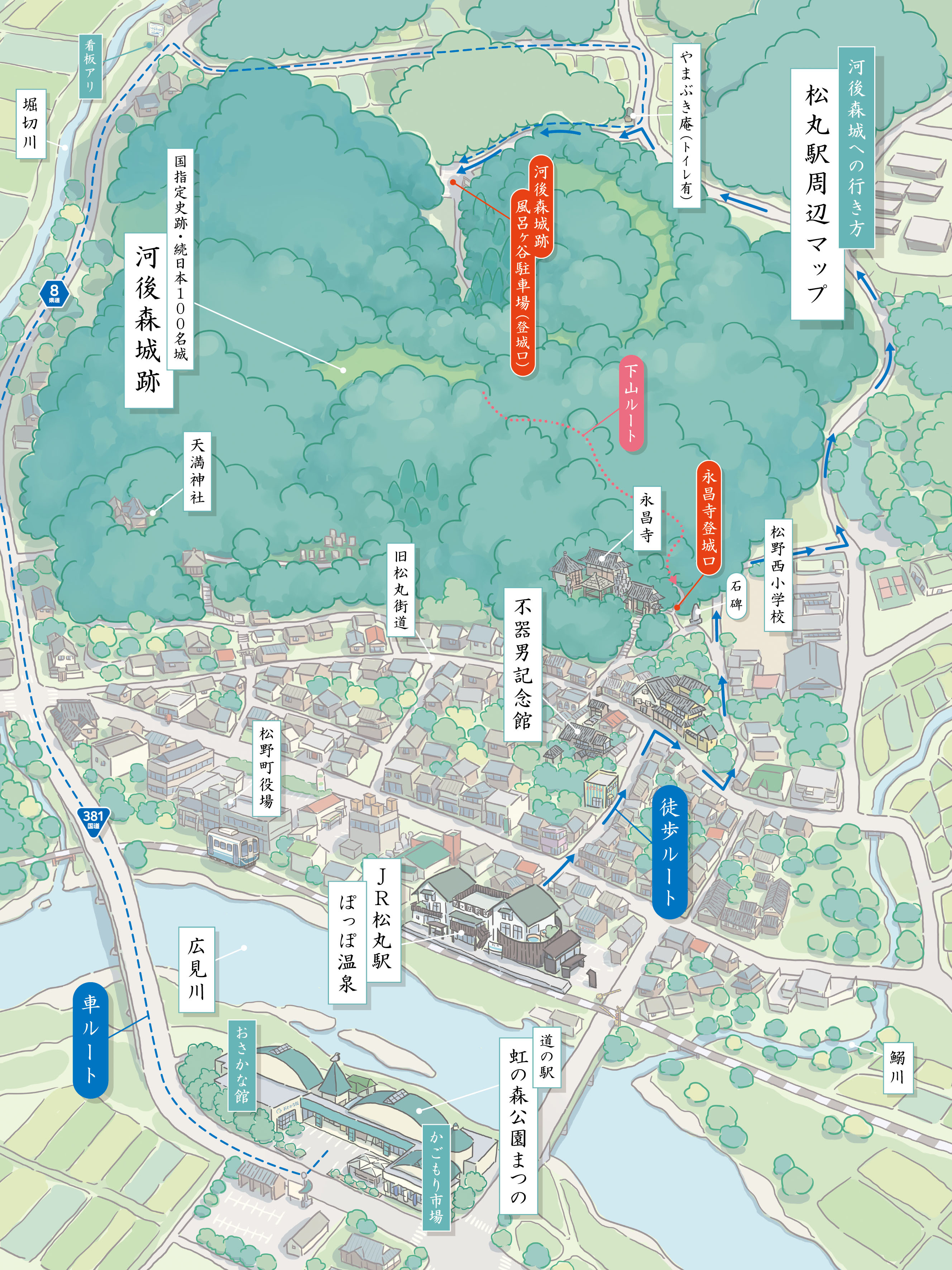
About 30 minutes on foot from the station via the Furogatani parking lot (trailhead) to the stamp at West Bailey No. 10. The town's map also shows a descent route down to the Eishōji trailhead.[1][5]
Checked: 2026-10-04
Hours and admission
Fukio Memorial Museum (Kagomori permanent exhibit; castle seals sold)
About 15 km from Mima IC on the Matsuyama Expressway toward Matsuno. Park at the Furogatani lot on the south side (about 10 cars; buses possible) and walk up; about 15 minutes to the stamp at West Bailey No. 10.[1]
Checked: 2026-10-04
Grounds opening hours
No time restrictions at the site (per the stamp information).[1]Checked: 2026-10-04
Time neededEditors' estimate
About two hours on foot from the station to see West Bailey No. 10 and the main enclosure.
Steps, slopes and footing
A climb on hill paths. The route south of the main enclosure has step-like footholds cut into the rock (an old path found by excavation and restored).[3][2]
Wheelchairs and strollers
No official information found. This is a mountain castle, not suited to wheelchairs or strollers.Checked: 2026-10-04
Toilets and rest
The town's map shows a toilet at Yamabuki-an near the Furogatani parking lot.[5]
English signs / audio guide
English information could not be confirmed.
Seasons
Native Rhododendron weyrichii azaleas grow on the Shinjō baileys, and a local group is transplanting them onto slopes without remains to create a flower spot (blooming season not stated officially).[2][6]
Photography
Not confirmed
Works, closures and restrictions
The town continues landscape and vegetation work on the site in 2026.[6]Checked: 2026-10-04
One minute's walk from JR Matsumaru Station, with a permanent display of panels and key finds from Kagomori Castle.[1]
Checked: 2026-10-04
Editors' guide
An editorial guide based on sources and confirmed information — not a first-hand visit report.
Who will enjoy it
Good for those who want to imagine the inside of a medieval mountain castle through reconstructed buildings, anyone drawn to the mystery of a vanished keep, and travelers combining the Yodo Line with a castle walk.
What makes it interesting
Start with the reconstructed building and gate at West Bailey No. 10 and look down on the trench. Then compare the main hall site with the early-modern stone walls in the main enclosure to see how a medieval castle was updated.
Before you go
Viewing the town's 3D keep reconstruction online before you go makes it easier to picture on site. Fukio Memorial Museum by the station displays finds from the castle (closed Tuesdays and Wednesdays).
Ways to enjoy it
If you also visit Uwajima Castle, keep in mind the story of the Tsukimi Yagura (no longer standing) that Kagomori's keep is said to have become, and the two castles start to connect.
Visitor reviews
Be the first to review
Have you visited this castle? We'd love to hear from you.
Write a review
Open questions
The move of the keep to Uwajima is a tradition; whether Kagomori had a keep is not settled, and no keep base has been found. The 3D keep is a proposal based on scholars' theories.
The 1615 abandonment is an inference, and the Kōri family's residence is also only said to have happened.
We could not find photos of Kagomori Castle with clear reuse terms on Wikimedia Commons, so none are included.
English signage, photo rules, castle seal prices and the azalea blooming season could not be confirmed.