About the Japanese on this page
Some Japanese is left here on purpose. **Source titles** are given as published, so you can find the original. **Addresses are shown in Japanese as well as romanised**, because Japanese is what works in a taxi or a map app. Shop names keep the Japanese alongside for the same reason. Everything else — hours, closing days, prices, seating, how to get there, and the articles — is in English, translated from the Japanese edition rather than machine-translated on the fly.
HISTORY
The history and culture of monjayaki
Monjayaki is known today as something you cook on a hot iron plate while drinking. It began as a sweet snack, made by children who could not afford paper or brushes and wrote letters on a shop's iron plate instead. That gap is the history of the dish.
- Monjiyaki — a sweet you wrote letters with
- The sweet shop's iron plate was a classroom
- Why Tsukishima
- Monja Street is a shopping street
- The difference from okonomiyaki is water and order
- The difference from takoyaki is the vessel
- How it is cooked — why you build a wall
- Cooking it at home
- In other regions it becomes another dish
- Monja now — mentaiko, mochi, cheese, and past it
- The fact that it has not gone abroad
- Chains redrew the map
- Visitors from abroad, and explaining how to cook
Edo to MeijiMonjiyaki — a sweet you wrote letters with
In Tokyo from the Edo into the Meiji period there was a penny sweet called monjiyaki, "letter-baking". A batter of wheat flour loosened with syrup was taken up on a small spoon and dribbled onto a copper plate as if writing characters, then eaten as soon as it set. The folklorist Shimizu Seifu recorded the scene in his Machi no Sugata.
"Moji" became "monji", and then "monja". The Ministry of Agriculture, Forestry and Fisheries gives the same derivation in its Uchi no Kyodo Ryori. The name of this dish comes from how it was played with, not how it tasted.
At this stage there is no cabbage and no dashi. It is a sweet. The only thing it shares with monjayaki today is that a loose batter is poured onto iron.
1945 to the 1960sThe sweet shop's iron plate was a classroom
In the food-short years after 1945, a plain monja of flour loosened with water and seasoned with soy sauce or syrup spread as a children's snack. The Ministry of Agriculture, Forestry and Fisheries records that children who could not get paper or writing tools were taught to form characters on the iron plate. The plate was both a playground and a classroom.
Through the 1950s and 1960s cabbage and tenkasu were added. This was the height of the penny-sweet-shop culture. The shops themselves then all but disappeared.
Monja survived because a handful of shops set themselves up as specialists after the sweet shops were gone. A children's snack became something adults ate with a drink.
1892 onwardsWhy Tsukishima
Tsukishima is not a natural island. It was built in 1892 (Meiji 25) from spoil dredged out of Tokyo Bay — the first reclaimed plot. Because an island had been built, it was called Tsukishima, "built island"; the characters were changed to "moon island" to avoid confusion with Tsukiji.
The blocks were laid out as squares of sixty ken (about 109 m), the Edo measure, enclosed by streets six ken (about 10.9 m) wide. Small blocks put houses close together, and that physical closeness made the downtown feeling.
The reclaimed land was quiet at first, grew as an industrial district from the late Meiji period, and by around 1921 Nishinaka-dori had become its commercial spine. A town of shipyards and factories had craftsmen living in it, penny sweet shops, and iron plates.
The monja shops only gathered on Nishinaka-dori in the Heisei period, from 1989. It was not "always a monja town". A few shops trying to keep the sweet shop taste alive made Tsukishima into a destination.
NowMonja Street is a shopping street
Tsukishima Nishinaka-dori shopping street, known as Monja Street, starts at Tsukishima subway station and runs through four blocks: Ichibangai, Nibangai, Sanbangai and Yonbangai. The monja shops are spread across those four.
The shops are organised by the Tsukishima Monja Promotion Cooperative, which runs the member list, group bookings, souvenirs and even an official character. The cooperative's member pages are the most reliable primary source on the monja shops of Tsukishima.
The Ministry of Agriculture, Forestry and Fisheries page says 54 member shops. As of August 2026 the cooperative's own site has member pages for 48 (one of which only points to the shop's own site, with no detail held by the cooperative). That the number moves is itself the current state of this street.
Part of the shopping street has been redeveloped, and some shops have moved into the ground floor of a tower block. Shopfronts from the Showa period and new-built lower floors now stand on the same street.
The difference from okonomiyaki is water and order
How they look is the result, not the cause. There are two causes.
The amount of water. Okonomiyaki batter is mixed with less water. Monja batter is mixed with more, so it never sets; you eat it while it is still loose on the plate.
The order of seasoning. Okonomiyaki is cooked and then sauced. Monja has Worcester sauce, soy sauce and dashi mixed into the batter before it is cooked. NTT Townpage's survey separates the two on the same two points.
The order in history is the opposite of the intuition: monja is older. Cooking flour loosened with water goes back to fu-no-yaki, became monjayaki in the Meiji period, and passed through issen-yoshoku on the way to okonomiyaki.
The difference from takoyaki is the vessel
Takoyaki uses a special plate of hemispherical wells that shut the batter into a ball. Monja uses a flat plate and shuts the batter into nothing.
That difference reaches all the way to how you eat. Takoyaki is handed to you finished; monja is cooked by the customer, continuously. Only monja does not finish being cooked before it reaches the table. Almost all of the difficulty of taking it abroad, described below, comes down to this.
How it is cooked — why you build a wall
The Ministry of Agriculture, Forestry and Fisheries publishes a recipe supplied by the cooperative. The bones of it are as follows.
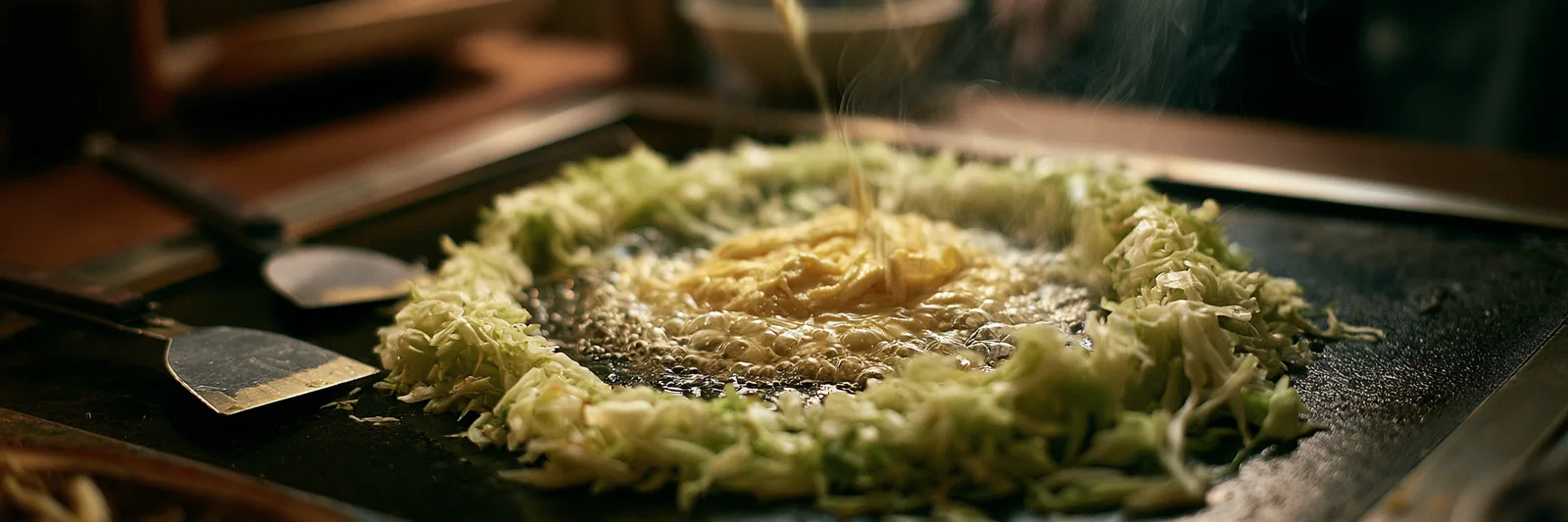
1) Put only the solid ingredients — cabbage, cut squid, tenkasu, dried shrimp and so on — on the plate first, draining them, and fry. 2) When the cabbage has softened, gather the ingredients with a spatula into a ring, like a doughnut. 3) Pour the batter left in the bowl into the middle of the ring. 4) When the surface bubbles, mix everything and spread it thin. 5) When the underside has browned, scrape it up with a small spatula and eat.
The ring is not decoration. The batter is watery; without a wall it runs across the plate and spreads out, and the heat reaches all of it at once. Walling it in and holding it in the centre lets you cook the batter first and mix the ingredients in afterwards — two stages instead of one.
The little spatula is the tableware. You do not serve it onto plates; you scrape the thin browned part straight off the iron and eat it. That is why it is small. This kit is what turns the time spent around the plate into the dish.
Cooking it at home
A tabletop hotplate is enough. The cooperative's recipe published by the Ministry of Agriculture, Forestry and Fisheries serves two or three and uses 350 cc of water to 30 g of flour. There is more than ten times as much water as flour. That is monja batter.
The backbone of the flavour is granulated Japanese dashi and Worcester sauce. For the solids, 300 g of cabbage with a little cut squid, tenkasu and dried shrimp; aonori, katsuobushi and pepper to finish.
The cooperative also makes and sells a monja set for home. In Isesaki, the junior chamber of commerce sells an "Isesaki monja set" in the same way.
In other regions it becomes another dish
Monja is a Tokyo dish, but there are separate lines outside Tokyo.
Isesaki monja, in Isesaki, Gunma, is said to have started when merchants from the textile town brought it back from trading trips to Tokyo. It is seasoned not with dashi but with strawberry syrup ("ama", sweet), curry powder ("kara", hot), or both ("amakara"). No ring is built and there are few ingredients. It is closer to a different dish that happens to share the name.
Tarashiyaki, in Oarai, Ibaraki, is a penny-sweet-shop taste running since the Taisho period, and it too builds no ring. Batter loosened with dashi is poured onto the plate and cooked until it sets.
Dondon-yaki, in Yamagata, is said to be Tokyo monja adapted for street stalls. It is wound onto disposable chopsticks so it can be carried.
The regional difference shows up in the statistics too. NTT Townpage's count as of 2014 put Tokyo first for monja shops per 100,000 people, Okinawa second and Gunma third. Five prefectures in Kyushu and Shikoku had no listing at all.
Monja now — mentaiko, mochi, cheese, and past it
The menus in Tsukishima today keep almost nothing of the penny sweet shop. Counting the dining tags mechanically across the 47 shops the cooperative describes in detail, "good seafood" and "lots of unusual dishes" tie at 26 shops each, the most common. Next come "Western-style monja", "can accommodate allergies" and "photogenic dishes".
The menu names bear this out: mapo tofu monja, wasabi monja, seafood curry monja, boiled sakura shrimp monja. Mentaiko-mochi-cheese now sits on the standard side, outside the unusual.
The range of accommodation has widened too. Shops offering a rice-flour batter for customers with a wheat allergy, and shops saying they will work with religious requirements, both appear in the cooperative's list. From "a child's snack at the penny sweet shop" to a restaurant in a tourist district expected to label allergens and work in several languages — the place this dish occupies has moved completely.
The fact that it has not gone abroad
Ramen, okonomiyaki and takoyaki are everywhere. Monja is almost nowhere.
In this survey we could confirm shops in only five countries or territories: Taiwan, South Korea, Thailand, Singapore and the United States. For the United Kingdom, France, Germany, Spain, Italy, Australia, Hong Kong, China, Malaysia, Indonesia, Vietnam, the Philippines, the UAE, Saudi Arabia and Canada, searching in English and in the local language did not reach a shop that names monja on its menu.
That does not mean it has stopped. On 7 August 2026 the Tsukishima specialist brand Moheji opened its first shop in South Korea, in Jongno, Seoul. It had already reached One Bangkok. Japanese monja specialists are moving, one by one, into large developments in Asian city centres.
Taiwan is where it has taken root most. A shop carrying "Tsukishima" in its name has run in Taipei's east district for more than twenty years, and forms have appeared there — monja with rice in it — that do not exist in Tsukishima. TEN-YA, opened in 2002, is described as Taiwan's first shop specialising in monjayaki, and has gone as far as an "Italian rice monja".
In the United States we could confirm one izakaya, in Gardena near Los Angeles. Not a specialist but a single line on a menu — which is exactly where monja stands in the English-speaking world.
Why it has not spread can only be estimated, but three reasons suggest themselves. Explaining how to cook it is expensive (the customer has to cook it). It does not sell in photographs (it never becomes a finished plate). It is a Tokyo-local food (it has had few chances to be introduced abroad as a regional dish).
Chains redrew the map
"You can only get monja in Tsukishima" is no longer true.
KISSUI GROUP Inc. (formerly Kano Corporation) runs monja shops under several brands — Moheji, Kuuya, Okoge, Tamatoya, Kotetsu, Doteya, Kato and others — and the shops on its official list run from Sapporo to Okinawa. Of the shops in Japan recorded in this database, those outside Tsukishima are almost all this group.
Among all-you-can-eat operators, Okonomiyaki Honpo includes monja in every course. Chains have made monja something you can eat wherever you happen to be.
That is a different product from the shops in Tsukishima. Putting an independent shop descended from a penny sweet shop and an all-you-can-eat counter in a station building side by side as the same "monja" does not help the reader. So this database always shows what kind of shop it is: specialist, chain, independent, long-established.
Visitors from abroad, and explaining how to cook
Of the 47 shops the cooperative describes in detail, 21 carry a tag saying overseas visitors are very welcome. Tsukishima has begun to assume foreign customers. But that is the shop's own declaration, and not confirmation that an English menu exists.
Monja has a structural obstacle here. It is a dish the customer cooks, so it is hard to bring off without a shared language. In practice many shops have switched to cooking it for the customer. Some of the cooperative's own descriptions say staff will cook it quickly for you.
Remove the need to explain the cooking, and you remove the time spent around the plate, which is the dish itself. The difficulty of going abroad and the difficulty of serving visitors are two sides of the same problem.