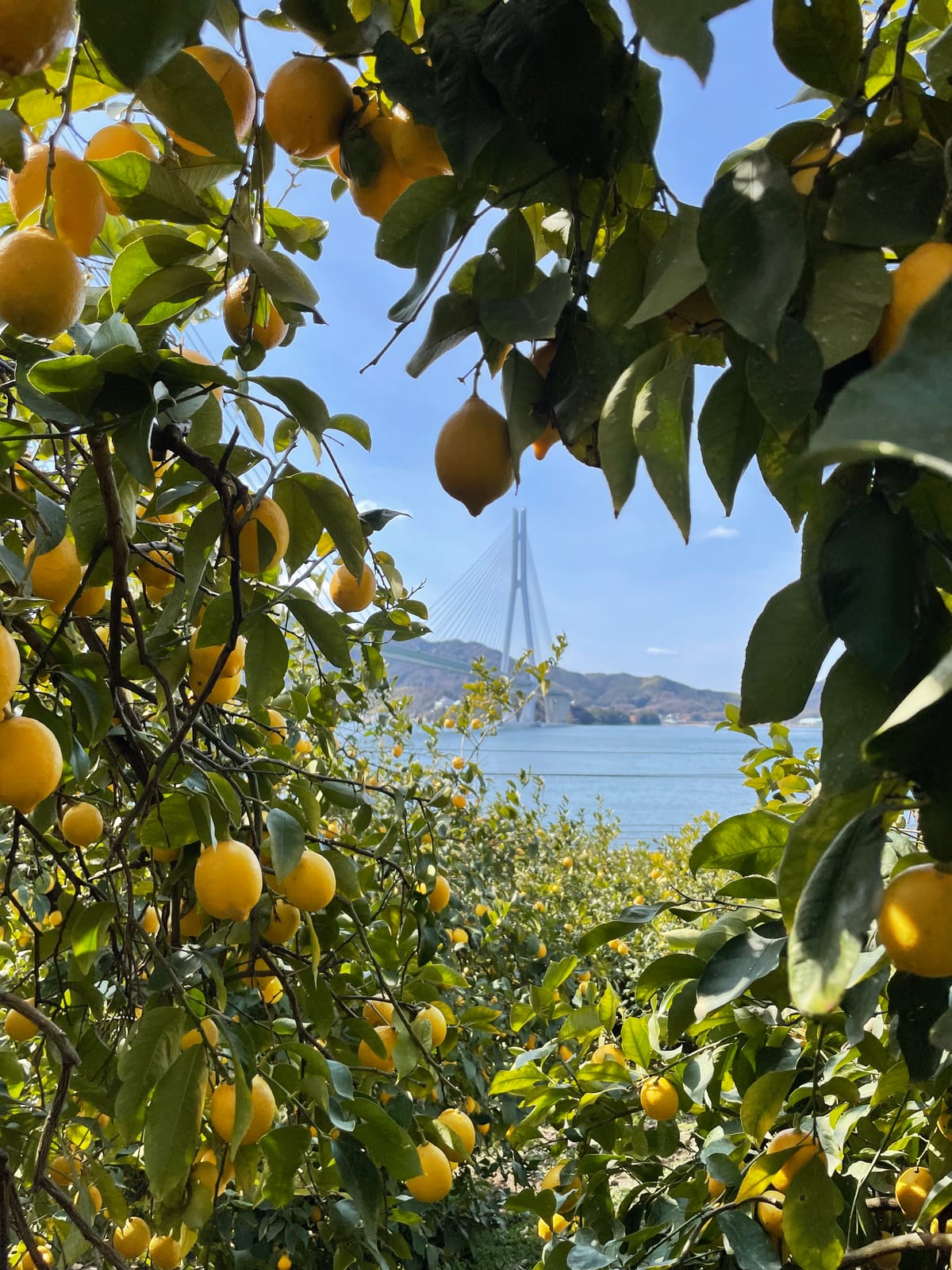
JA Hiroshima's material describes Ikuchijima and Kōnejima as mild and relatively dry, with soils that are mostly well-drained granite. Half of the land is steep slope. Citrus grows on terraced plots that catch the light reflected off the sea.
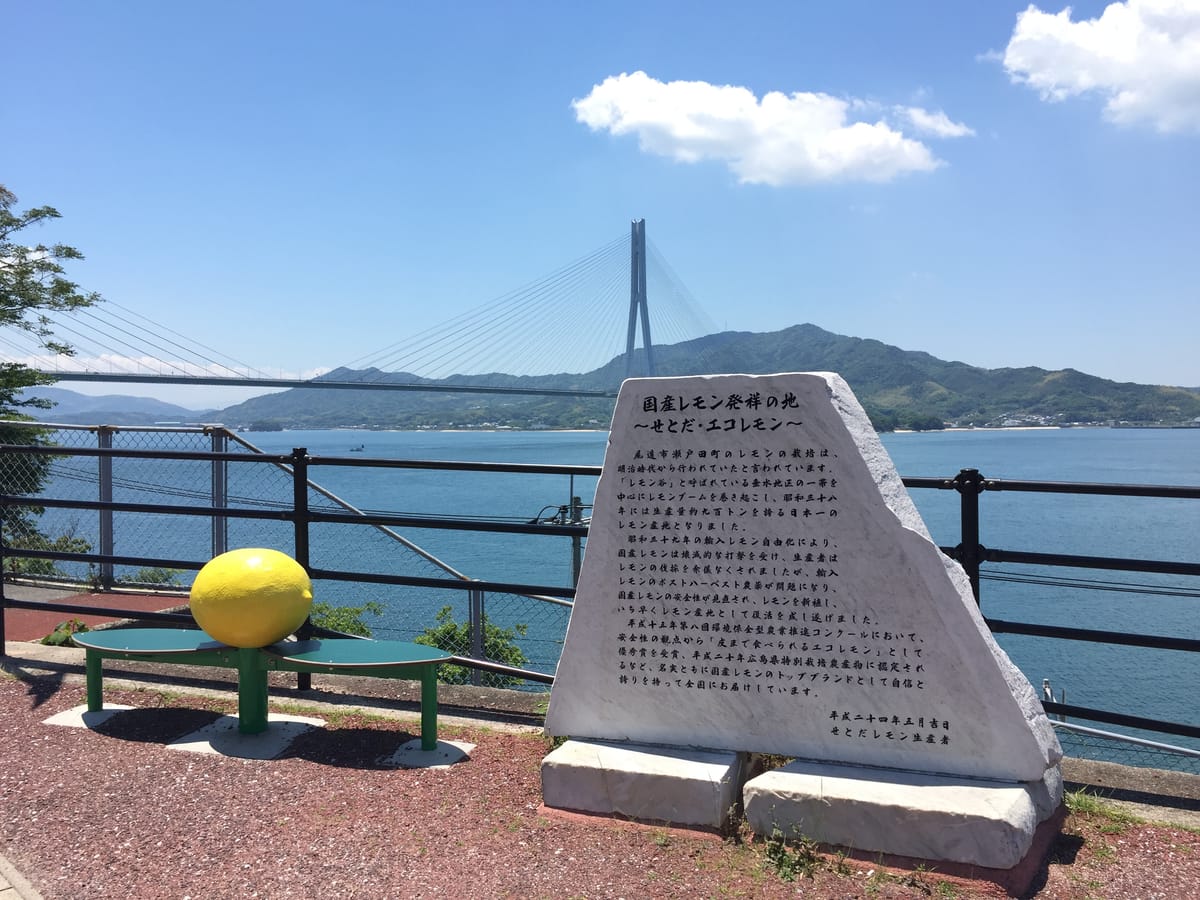
The monument marking Setoda as “the birthplace of Japanese-grown lemons”, with the Tatara Bridge beyond. Tarumi, Setoda.
01
From Lemon Valley
Lemons are said to have been grown in Setoda since the Meiji era. A concerted effort to build a growing area began in 1927. The Tarumi district came to be known as “Lemon Valley”, and by 1963 Setoda was producing about 900 tonnes, the most of any area in Japan at the time.16
02
Imports arrive
In 1964, lemon imports were liberalised. Japanese lemons were hit hard; growers cut down their trees and most of the orchards disappeared.17
Photo: J-Catalyst
A grower harvesting lemons in Setoda.
03
Planting again
In time, the value of home-grown lemons was recognised again. Led by the agricultural cooperative, the whole island joined a campaign in which every household planted one are (100 m²) of lemons. The orchards came back, and growers today continue to aim for a lemon that can be eaten peel and all.17
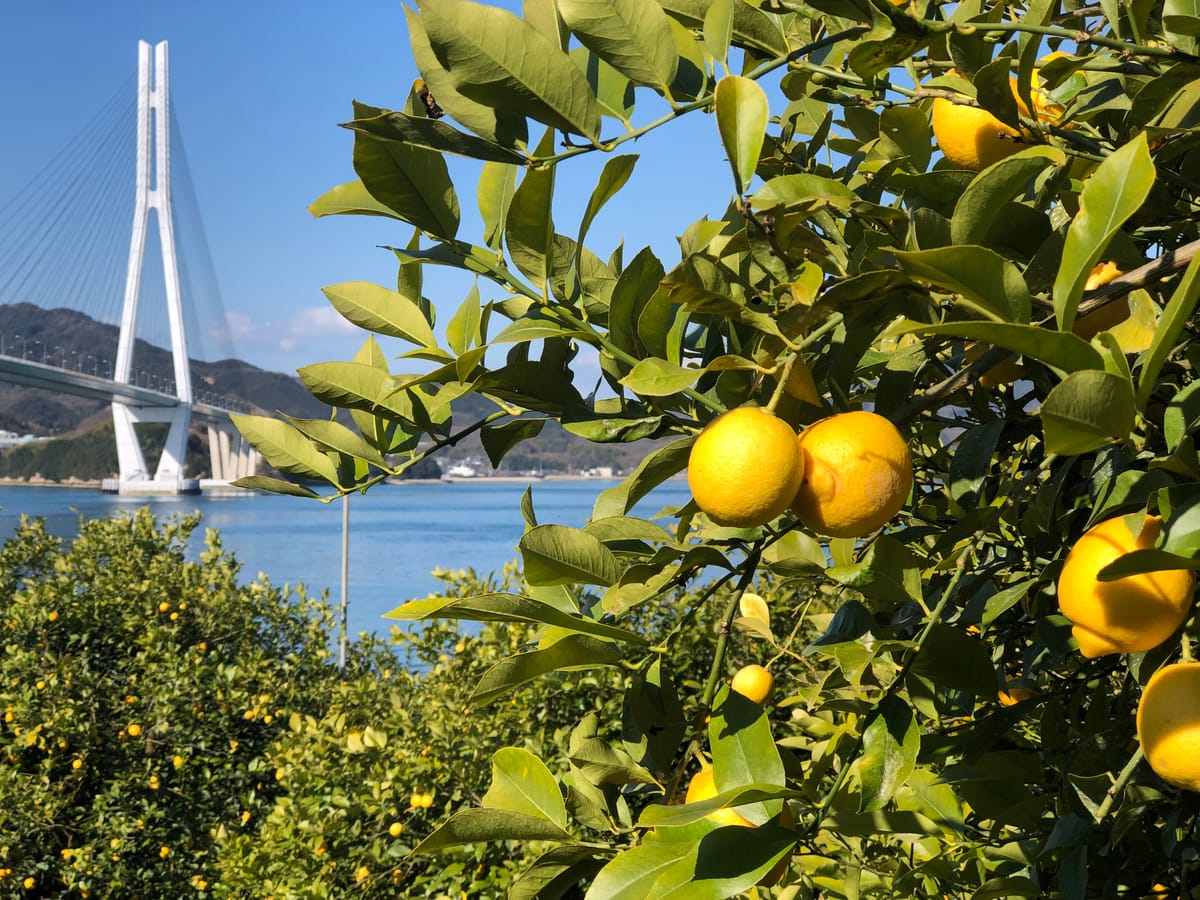
Ikuchijima from the Tatara Bridge: the coast road and citrus groves on the slopes.
04
A year-round supply
Open fields from autumn to spring, cold storage in freshness-preserving film, and greenhouses in summer: together these three methods now supply lemons through the year.1213
A Setoda lemon timeline
Based on JA Hiroshima's booklet “Setoda Citrus, 2026”.
The Setoda Eco Lemon Group receives the Emperor's Cup at the 62nd Agriculture, Forestry and Fisheries Festival.19
Two names
Setoda Lemon and Setoda Eco Lemon®
01
Setoda Lemon
On this site, the name for lemons grown in Setoda (Ikuchijima and Kōnejima) and shipped through JA Hiroshima's Setoda packing house.
02
Setoda Eco Lemon®
Within that, lemons certified under Hiroshima Prefecture's special cultivation scheme. The name is a registered trademark of JA Hiroshima. “Eco” here does not mean certified organic.12
Which grades and categories we can supply varies with the season; we will advise when you get in touch.
Growing
Grown and handled with the peel in mind.
01
What “specially cultivated” means
In Japan, “specially cultivated” produce is grown with both the number of synthetic pesticide applications and the nitrogen from chemical fertiliser reduced to half or less of the usual practice in that region. Setoda Eco Lemon® has been certified by Hiroshima Prefecture since 2008. It does not mean pesticide-free, and it is a different scheme from Japan's organic (JAS) certification.2
02
No fungicide or wax treatment
JA Hiroshima's leaflet states that Setoda Eco Lemon® is not treated with fungicide or wax. For cooks who grate, preserve or simmer the peel, that is a useful thing to know.1
03
Working to GAP principles
GAP (Good Agricultural Practice) is a way of managing farms that keeps both the produce and the people working there safe. Setoda's growers manage their orchards along these lines.5
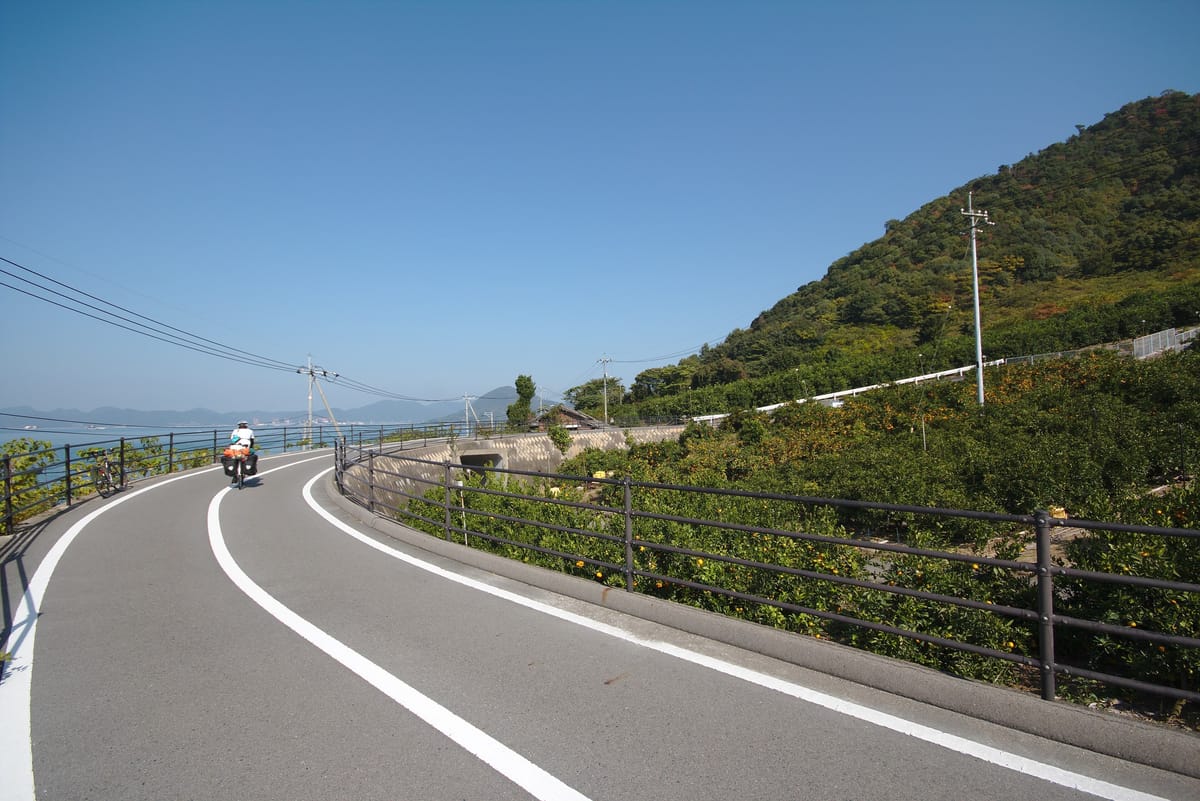
The cycle path climbing to the Tatara Bridge on Ikuchijima, beside citrus groves.
Households shipping lemons via the Setoda packing house, 2025 crop
All lemons
374
Setoda Eco Lemon® (specially cultivated)
122
Hiroshima Lemon (standard)
288
Greenhouse lemons
6
A household may ship in more than one category, so the breakdown does not sum to the total. The figures of 120 (fiscal 2026) and 122 (2025 crop) refer to different years.4
Recognition
An award for the growers.
At the 62nd Agriculture, Forestry and Fisheries Festival (fiscal 2023), the Setoda Eco Lemon Group, an association of growers, received the Emperor's Cup in the horticulture category. The festival is a national programme, organised with Japan's Ministry of Agriculture, Forestry and Fisheries, that honours outstanding work in farming, forestry and fisheries; the Emperor's Cup is the top award in each category. The group was recognised for its sustained special cultivation and its work on distribution and product development.19
The award was made to the growers' group. It is not a product endorsement by the Imperial Household.
We deliver our lemons across Japan with confidence and pride, as a leading name in Japanese-grown lemons in both reputation and substance.
Setoda lemon growers, from a message dated May 2012JA-BOOK
Shapes & products
A slice that brings a little delight to the table.
Heart Lemon® and Star Lemon® are grown inside moulds fitted while the fruit is still small. Slice one, and a heart or a star appears: on the rim of a glass, on a dessert plate, at a celebration. The growers have also developed a wide range of products made with Eco Lemon.
Please ask us about specifications and availability.2122