04 — Arts
Arts and training
The point of being a maiko is not to become a picture. It is to acquire an art that takes years and does not stop at erikae.
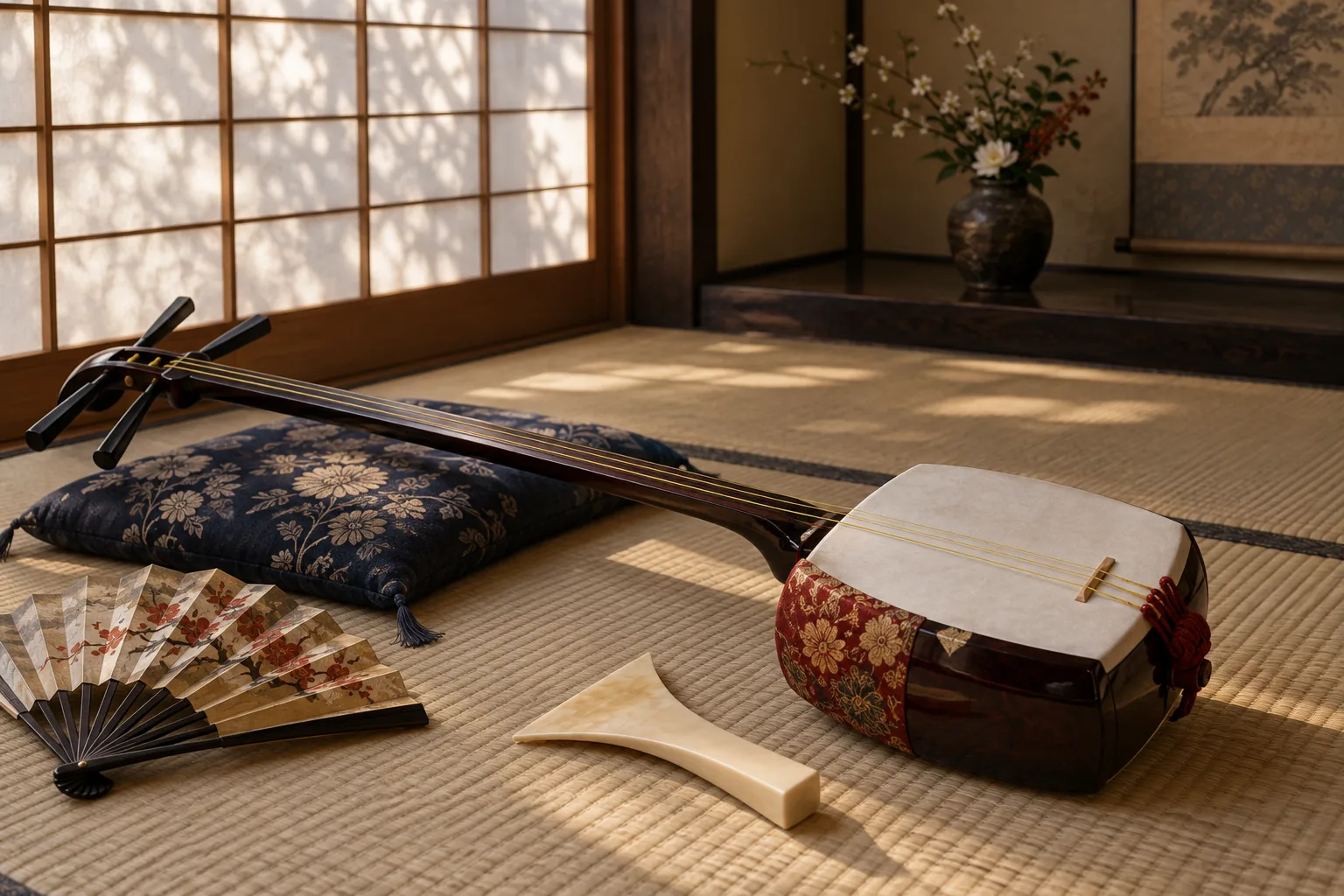
Kyoto City lists the arts a maiko studies: dance, nagauta, kouta, tokiwazu, kiyomoto, drums, flute, koto, tea, calligraphy and flowers.
Dance: one school per kagai
Each kagai keeps one dance school: Gion Kobu = Kyomai Inoue-ryu; Miyagawa-cho = Wakayagi-ryu; Pontocho = Onoe-ryu; Kamishichiken = Hanayagi-ryu; Gion Higashi = Fujima-ryu. Kyomai (Inoue-ryu) is a Kyoto 'mai' style of about 200 years, passed down mainly by women, shaped by Noh and puppet theatre, with a low, forward-weighted posture and restrained movement; it is called 'mai' rather than 'odori'. The current fifth-generation Inoue Yachiyo teaches Gion Kobu's geiko and maiko and directs the Miyako Odori and Onshukai.
Songs: nagauta, kouta, tokiwazu, kiyomoto
Kyoto City lists nagauta, kouta, tokiwazu and kiyomoto among the arts studied. 'Gion Kouta' is described by the Foundation as the first song a maiko learns; a Gion Kouta festival is held each November at Maruyama Park.
Shamisen
Three-stringed lute that accompanies dance and songs at ozashiki and on stage. Geiko who specialise in music (jikata) play it; it is a required subject at the Gion Kobu school.
Hayashi: drums and flute
Percussion (kotsuzumi, otsuzumi, taiko) and flute are part of the curriculum, used in stage pieces and in some ozashiki numbers. Koto is also listed.
Sources
Tea ceremony
Learned as hospitality training; at the spring and autumn odori, geiko and maiko serve tea to ticket holders before the show (tea-ceremony seats are sold for Miyako Odori, Gion Odori, etc.).
Ikebana and calligraphy
Kyoto City lists flower arrangement and calligraphy among the refinements studied alongside performing arts.
Sources
Etiquette and Kyoto dialect
Learned mainly during shikomi: kagai manners, how to sit, serve, greet, and the soft Kyoto kagai speech. The official site calls dialect as important as dance.
Sources
Ozashiki asobi (parlour games)
Simple games played with guests, usually to a jikata's song, with the loser drinking a penalty cup. Tora-tora (also 'Watonai'): two players behind a screen strike a pose on the beat: Watonai with a spear beats the tiger, the tiger beats the old mother with a stick, the old mother beats Watonai (rock-paper-scissors logic). Konpira fune fune: two people face each other over a small stand (often a beer-bottle cap or sake-cup stand); to the song 'oite ni ho kakete shura shu shu shu' they alternately tap; if the stand is there you touch it with an open hand, if the other person has taken it you tap with a fist; a mistake loses. The NDL reference database lists 16 published books on Kyoto ozashiki games including works by Aihara Kyoko (Bungeishunju 2001; Kobundo 2007), 'Gion no Shikitari' (Seishin Shuppansha 2009), and 'Pontocho no Subete' (Tankosha 2010).