06 · Kagai 02
Miyagawacho
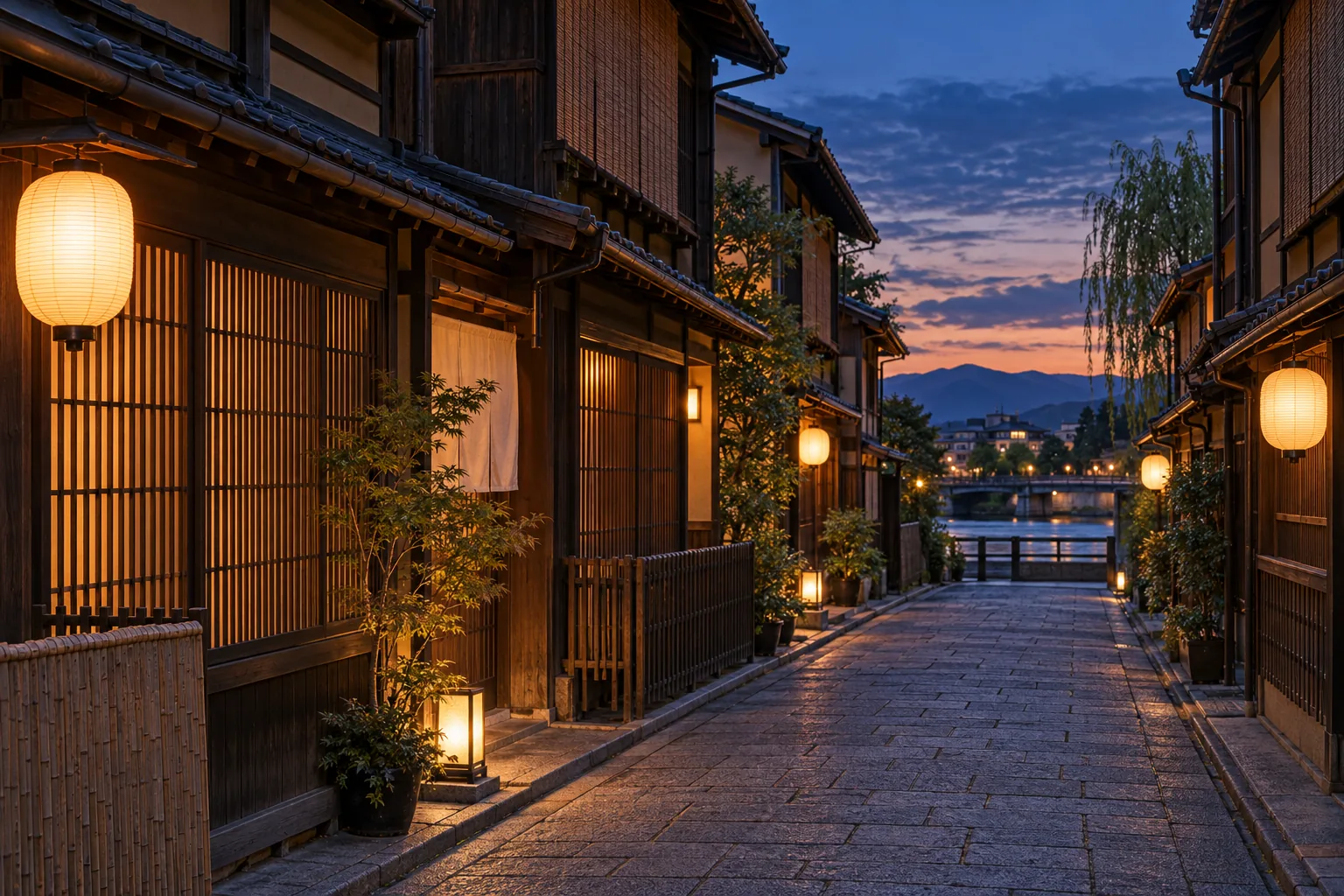
Quiet lanes of two-storey wooden houses with lattice fronts and name plates of okiya; more of a lived-in neighbourhood feel than Gion. The Kaburenjo (rebuilt, with a theatre called Mitsuwaza) sits in the middle of the district.
- Location
- On the east (left) bank of the Kamo River in Higashiyama Ward, south of Shijo-dori toward Gojo-dori, along Miyagawa-suji 2-chome to 6-chome. A short walk south of Gion but noticeably more residential.
- History
- The district's name is said to come from the Kamo River stretch used for Gion Festival purification rites, which was called the Miyagawa. Its entertainment origins go back to the early Edo period (Keicho era), when Izumo no Okuni's kabuki dancing drew crowds to the riverbank; it later developed into a teahouse street. The spring performance, Kyo Odori, began in 1950.
- Dance school
- Wakayagi school (Nihon buyo)
- Theatre
- Miyagawacho Kaburenjo, theatre 'Mitsuwaza' (306 Miyagawa-suji 4-chome, Higashiyama-ku)
- Crest
- Three linked rings (mitsuwa)
- Performances
- Kyo Odori — First half of April
- Mizuekai — Early-to-mid October
- Miyako no Nigiwai (Joint Performance of the Five Kagai) — Late June, one weekend
- Nearest stations
- Gion-Shijo Station (Keihan Line), about 7 min on foot
- Kiyomizu-Gojo Station (Keihan Line), about 7 min on foot
- Kyoto-Kawaramachi Station (Hankyu Line), about 10 min on foot
- City bus stop 'Kawaramachi-Matsubara' (routes 4/7/205), about 7 min
- Walking notes
- From Gion-Shijo Station cross to the east bank and walk south along Kawabata-dori, then one street in; Miyagawa-suji runs parallel to the river. Keep voices low in the evening; these are working streets and homes.
- Official site
- https://www.miyagawacho.jp/
Sources
- 五花街の紹介 | ookinizaidan.com
- 五花街の紹介 | 京都をつなぐ無形文化遺産 (Kyoto City)
- 京おどり | 【公式】京都 宮川町
- 第75回京おどり | 京都観光Navi (Kyoto City)