What is published
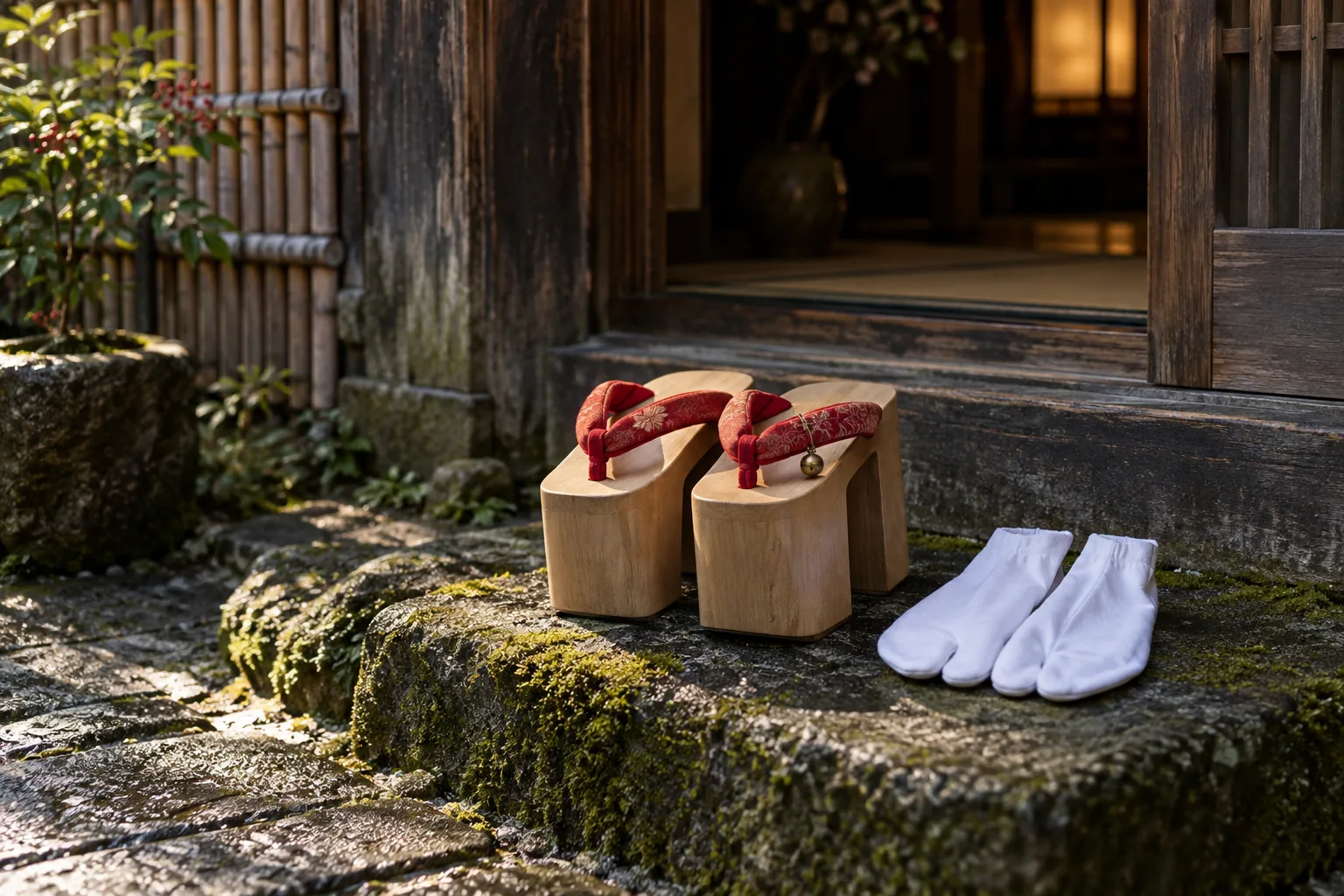
The Foundation gives the darari obi at about five metres and calls it very heavy, heavy enough that a dresser ties it. The Kyoto City guide gives the okobo at about twelve centimetres. The hem of the kimono trails, and outdoors the maiko gathers the left side in her hand. Those are the facts; everything below is expectation.
What a dancer expects, as hypotheses
In nihon buyo we spend years learning to keep the centre of gravity low and the upper body still. A trailing hem should force the same habit: lift the knee and the hem would catch; slide the foot and it follows. Tall okobo should shorten the stride. An obi hanging behind should shift weight backward and slow every turn. If that is right, much of the walk that visitors find charming is physics, mastered. It may be wrong in detail, which is why it is written down before the visit.
Why this connects to etiquette
If the hypotheses hold, a person walking on stone in okobo cannot step aside quickly, cannot run, and sees her own feet poorly in the dark. A flash in front of her would then be a safety problem, not a matter of vanity. The rule about flash exists regardless; the mechanics are what we hope to confirm.
What we will try to measure
Not to 'be a maiko for a day': a makeover costume is a different garment and its wearer is not trained. But a studio may let us walk a few metres in okobo and hold an obi of real length, and a dresser may agree to talk. We will record the weights and lengths we are shown, with the source of each, and rewrite this note with what we actually found.